Overview
The Overview is where you come to see how you're actually doing — not just what's due, but how consistent your effort has been over time.
What it shows
- Active goals and their current progress
- Tasks due today and coming up soon
- Today's routines and whether you've completed them
- Habit heatmaps — a visual record of how your key routine metrics have trended over time
How to use it
The Overview is most valuable as a periodic check-in — not a minute-by-minute dashboard. Open it when you want a honest read on how things are going: are your metrics trending in the right direction? Are your goal progress bars moving? Is there a gap in the heatmap you want to close?
For managing what to do next, the Tasks screen is more useful. The Overview operates at a higher level — it's less about what's on your plate today and more about the shape of your habits over time: whether you're growing, whether you're consistent, whether the things you care about are actually getting your attention.
When it feels sparse
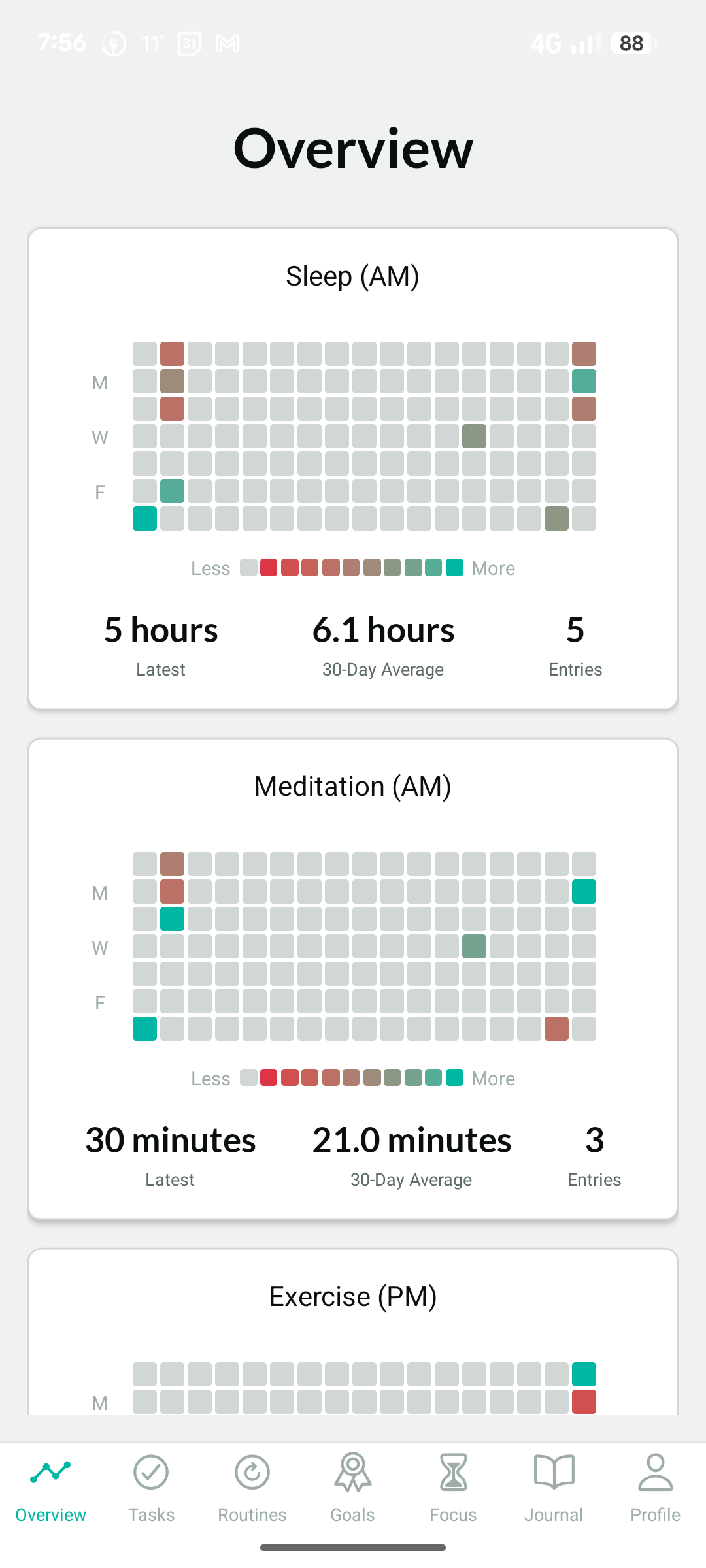
In the early days, the Overview might not show much. That's normal — it reflects what you've set up. A few tasks and no routines means a mostly empty dashboard.
The habit heatmaps don't get interesting until you have a few weeks of metric data. The goal progress doesn't move until you've linked routines and tasks to a goal.
Give it time. The Overview is a lagging indicator. It shows where you've been, which only gets useful once you have somewhere to show.
The Overview's value scales with your use of routines and metrics. If it feels empty, the answer is usually to add a metric or two to your routine — not to add more tasks.
Metrics as evidence
One of the quieter things the Overview does is correct the stories you tell yourself. When the heatmap shows three weeks of consistent sleep or a month of daily exercise, "I never follow through" doesn't hold up against the evidence. It's not a feeling anymore — it's a fact you can see.
This is why the Overview is worth building toward even if it feels sparse at first. Give it a few weeks of honest metric tracking. The payoff is real.
The motivational loop
Once metric data starts accumulating, something shifts. Seeing a heatmap fill in — even partially — motivates you to check in with a routine, even on a low-energy day. A token effort still counts. The streak stays alive. The heatmap stays warm.
This is why setting your metric ranges realistically low matters. A target you can hit on a hard day is more valuable than an aspirational one you miss half the time. Hitting a modest target consistently feels better — and is more accurate — than occasional high performance punctuated by gaps.
The Overview makes consistency visible. That's what makes it motivating over time.