Routines
A routine is a repeating structure you complete on a regular schedule. It's not a to-do list — it's a rhythm.
How routines work
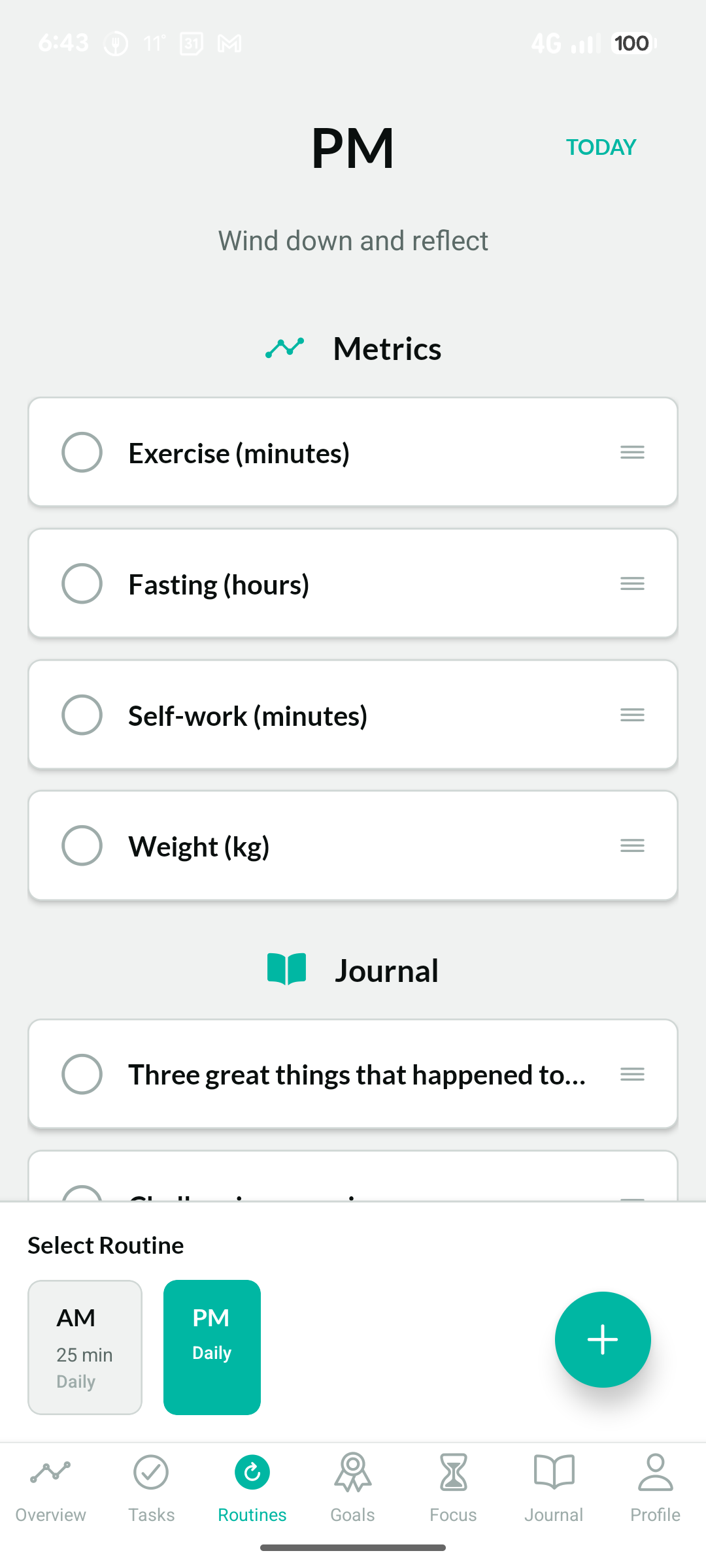
Each routine has steps. Steps can be task steps, metrics, or journal prompts. Each day, the routine resets: a new instance is ready to complete, independent of yesterday's.
You build a routine once and complete it repeatedly. The more you complete it, the more data it generates — and data, over time, tells you something true about how you're actually living.
The value of a routine isn't in completing it once. It's in what the data tells you after weeks of doing it.
Three kinds of steps
Tasks
A task is a binary: done or not done. "Take medication." "Tuck in the kids." "Review today's tasks." Task steps create the habit of moving through the routine and ensure the basics happen.
Metrics
A metric is a number you record during your routine. Unlike a task step, it has a value — and that value accumulates meaning over time. How many hours did you sleep? How many minutes did you exercise? What's your weight today?
Metrics are how the routine stops being a checklist and starts being a record. See the Routines guide for more on what's worth tracking and why.
Journal prompts
A journal prompt is a question built into your routine. You answer it as part of completing the routine — no separate journaling habit required. Tapping a prompt opens a full-screen text editor, giving you space to write without distraction.
For prompt ideas and how to make the most of them, see Journal.
The daily reset
Routines reset at the start of each day. Whether you completed yesterday's fully, partially, or not at all, today is a fresh instance.
This isn't about letting yourself off the hook. It's about making it possible to start fresh without carrying the weight of accumulated incompleteness. Every day is a new chance to show up.
A missed day isn't a broken streak. It's just yesterday. Today is its own thing.
Linking to goals
A routine can be linked to a goal. When you complete the routine — or meaningful portions of it — that counts toward your goal's streak and progress.
Goals build on and provide direction to routines. A routine that tracks your sleep, exercise, and mood, linked to a health goal, means every morning check-in is directly visible as goal progress.
Reordering tasks
Within a routine, you can change the order of task steps by long-pressing a step and dragging it to a new position. The order is saved immediately — your routine will always run in the sequence you set.
Routine preferences
You can edit a routine at any time — add or remove steps, reorder them, or rename it.
Routines aren't all daily. You can set the cadence to match what you're tracking:
- Daily — for habits you want to build consistently, like a morning or evening routine
- Weekly — for recurring check-ins or a weekly review
- Monthly — for things like paying bills or reviewing your goals
Start with one simple daily routine before adding more. A routine with three steps you actually do beats one with ten steps you abandon.